The situation
OBScoreboard sells live scoreboard overlays that plug into OBS, vMix and Streamlabs. The buyers are sports streamers, school and club media teams, small leagues and production crews who need a clean score bug on a live stream without hiring a graphics operator. It is a classic long-tail SaaS: thousands of tiny, very specific searches ('cricket scoreboard for OBS', 'vMix basketball scorebug', 'how to add a live score to Streamlabs') and almost no single head term worth fighting for.
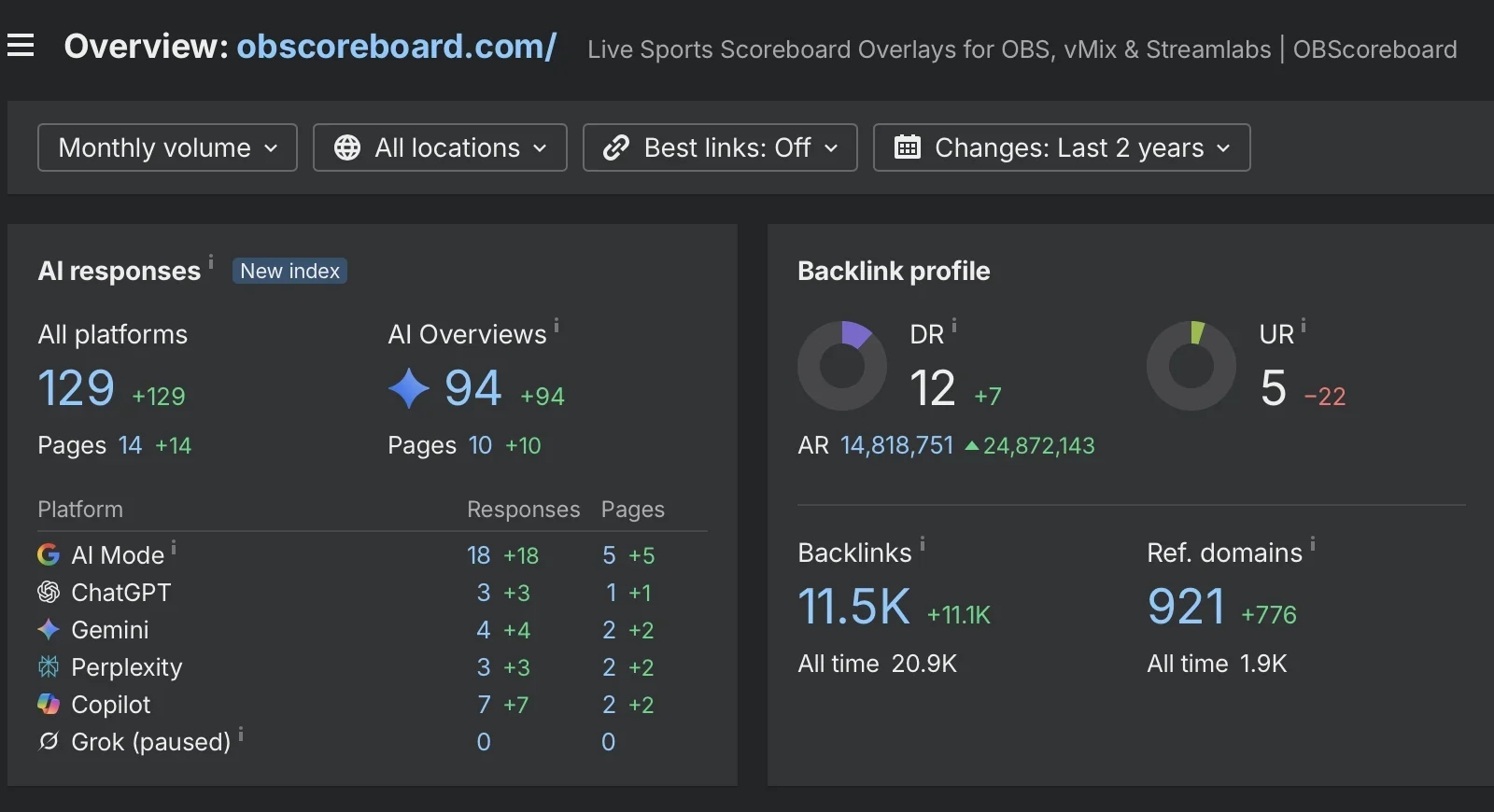
That long tail is exactly where AI answers now sit. When someone asks Google or ChatGPT how to put a live score on a stream, the engine writes a step-by-step answer and cites a handful of sources. Before this program, obscoreboard.com was cited in zero AI responses. The site had a Domain Rating of 5 and 145 referring domains, which in practice meant Google had little reason to trust it over a forum thread or a YouTube tutorial from someone else.
The goal was not traffic for its own sake. It was to become the source AI engines quote when a streamer asks how to do the exact job OBScoreboard does, so the product name appears inside the answer itself.
01How does Google AI Overviews actually choose which pages to cite?
Google does not run one search when it builds an AI Overview. It runs a query fan-out: the model breaks the question into several sub-queries ('what software overlays scores on OBS', 'is there a free option', 'how to connect a scoreboard to vMix', 'does it work on mobile streams'), retrieves results for each, and then stitches an answer from the passages that best answer each sub-question. AI Mode does the same thing with even more sub-queries.
Two consequences follow. First, a page can be cited for a question it never ranked on page one for, because it won a sub-query. Second, retrieval is passage-level. Google is not quoting your page, it is quoting a short block of a few sentences on your page that answers one sub-question cleanly. If that answer is buried under a hero image, a sales intro and three paragraphs of context, a competitor's tidier passage wins.
The third filter is trust. Among the passages that answer the sub-query, Google leans toward sources from its normal ranking system, which still weighs links, entity clarity and site reputation. That is why a technically perfect page on a DR 5 site loses to a mediocre Reddit thread: Reddit has the trust, the small SaaS does not yet.
- Answer the sub-question in the first two sentences under each heading, then elaborate.
- Write headings as the literal question a user would ask ('How do I add a live score to OBS?').
- Use numbered steps for procedures. Engines lift ordered lists almost intact.
- Mark up the page with SoftwareApplication, HowTo-style structure and FAQPage where it matches visible content, so the entity is unambiguous.
02Why build a page for every streaming tool and every sport?
A SaaS like OBScoreboard has a natural matrix: three host tools (OBS, vMix, Streamlabs) multiplied by every sport a streamer covers (football, basketball, cricket, volleyball, hockey, esports and more). Each cell of that matrix is a distinct question with distinct intent, and each one is a fan-out sub-query waiting for a clean answer.
The play is a programmatic page set built on a real template, not a spun one. Each page covers one tool and sport combination with the specifics that actually differ: how the browser source or input is added in that tool, which fields that sport needs (overs and wickets, quarters and fouls, sets and serve), what the overlay looks like, and the common failure for that setup. The shared parts come from a component, the differing parts are written by someone who has actually set the overlay up.
This is where most programmatic SEO fails. Pages that differ only by a swapped keyword are near-duplicates, Google folds them together, and AI engines have nothing unique to quote. Pages that each carry one genuinely different procedure become citable. The test we apply is simple: if you deleted the sport name, could you tell which page you were on? If not, the page is not ready.
- Integration hub pages: one per host tool, linking down to every sport page for that tool.
- Sport hub pages: one per sport, linking across to every tool page for that sport.
- Troubleshooting passages per tool ('overlay not updating in vMix', 'browser source shows black in OBS').
- A comparison passage on each hub that names alternatives honestly, because 'what is the best' is always one of the fan-out sub-queries.
03Why do referring domains correlate with AI Overview citations?
Over the same period the AI citations appeared, OBScoreboard's referring domains went from 145 to 921 and Domain Rating from 5 to 12. That is not a coincidence. AI Overviews draw from pages Google already considers rankable, and the count of distinct, relevant sites linking to you is still one of the strongest inputs into that judgement.
The key word is distinct. Ten thousand links from one site add little. Hundreds of different domains each linking once, from streaming blogs, tool directories, league sites, school media pages and tutorial creators, is what moves the needle, because each one is an independent vote that the site belongs in the conversation about live sports streaming.
There is a second, quieter effect. Many of those linking pages mention OBScoreboard by name next to words like 'OBS', 'vMix', 'scoreboard' and 'overlay'. Those co-occurrences teach both Google and the language models behind ChatGPT and Gemini what the brand is. Entity understanding is built from mentions as much as from links.
- Directory and marketplace listings: streaming tool directories, SaaS directories, and alternative-to pages.
- Integration ecosystem: plugin lists, community resource pages and 'tools for streamers' roundups.
- Customer sites: leagues, clubs and schools that stream their games and credit the overlay they use.
- Creator links: tutorial makers who link the tool in their video descriptions and blog write-ups.
04How do you market a streaming SaaS on Reddit without getting banned?Grey area
Reddit matters twice for a product like this. Its threads rank in Google for almost every 'how do I' streaming question, and they are among the most cited sources in AI answers across ChatGPT, Perplexity and Google. A good thread in the right subreddit is both a source of buyers and a source AI engines quote.
The communities for this niche are obvious: r/obs, r/Twitch, r/streaming, r/vmix, plus the subreddit for each sport where club and amateur streamers hang out. The method is the same in each. Comment first, post later. The account that eventually mentions the product should have weeks of genuinely helpful answers to setup questions behind it: fixing audio sync, explaining browser sources, recommending capture settings. Moderators and users check post history, and an account that only ever talks about one tool gets removed.
Then the play is a 4-post campaign rather than one big launch. Post one is a useful how-to with no link ('How I added a live cricket score to my OBS stream for free'). Post two answers the objections that thread surfaces. Post three is a show-and-tell with a short screen recording of the overlay running live. Post four is the honest comparison, including when a competitor is the better choice. Each one is written so a reader learns something even if they never click.
Disclosure is not optional. When the founder or a team member mentions OBScoreboard, they say they work on it. In streaming subreddits that disclosure usually helps: people would rather hear from the builder who can answer setup questions than from a fake happy customer.
- Account age and karma: let accounts build history in the subreddit before any product mention.
- Read each subreddit's self-promotion rule. Several streaming subs allow tools only in weekly threads.
- Lead with a screen recording. In streaming communities a 20 second clip beats any paragraph.
- Answer every reply in the first hours. Comment depth is what keeps a thread alive and indexable.
- Launch-video boost: when a new feature ships, post the demo clip natively to Reddit and upvote nothing artificially. Let the clip earn it.
This is the playbook we would run for you
Talk to Prithvi for 30 minutes about your category. You leave with the prompts your buyers type and who AI shows them today.
05Why do AI engines quote Reddit threads so often?
Reddit threads have three properties AI engines love. They are phrased as real questions in the user's own words, which match fan-out sub-queries closely. They contain multiple independent answers, which reads as consensus. And the best answers are short, specific and experiential: 'I use X with OBS, set the browser source to 1920x1080 and it updates every second.' That is a perfectly sized, quotable passage.
Google's licensing deal with Reddit and the platform's general visibility in search mean those threads are also crawled fast and ranked well. For a small SaaS, the practical lesson is that the Reddit thread answering 'best scoreboard overlay for OBS' is part of your site's AI footprint whether you like it or not. Being present and accurate in that thread, with disclosure, is often a faster route into AI answers than anything on your own domain.
06How do YouTube tutorials get a SaaS into AI answers?
Setup questions in streaming are visual, and YouTube owns them. Google surfaces videos inside AI Overviews and AI Mode, and the engines read the transcript, the title, the description and the chapter markers. A tutorial titled with the exact question and chaptered by step gives the engine timestamped passages to cite.
The play is one short tutorial per high-intent cell of the matrix: 'Add a live basketball scoreboard in OBS in 3 minutes', 'vMix scoreboard input setup', 'Streamlabs score overlay for school sports'. Say the steps out loud in plain words, because the transcript is the text the engine reads. Add chapters named as sub-questions. Put the matching page link first in the description, and embed the video on that page so the page and the video reinforce each other.
Creator partnerships multiply this. A streaming-gear YouTuber who shows the overlay in a 'my stream setup' video creates a third-party mention, a description link and a transcript passage in one go.
- Title = the question. Chapters = the steps. Description first line = the answer in one sentence.
- Upload accurate captions rather than relying on auto-captions that mangle product names.
- Shorts showing the overlay live are discovery, long tutorials are what gets cited.
07Do LinkedIn and X matter for a prosumer SaaS?Grey area
Less for direct buyers, more for authority. The B2B side of OBScoreboard's market, league operators, athletic departments and production companies, does read LinkedIn. Founder posts showing how a league streamed a tournament with a two-person crew earn comments from exactly those buyers, and a LinkedIn article on the same topic sits on a high-authority domain that Google indexes quickly.
That is the grey-but-legitimate move: publishing genuinely useful guides on high-authority UGC hosts (LinkedIn articles, Medium, a public GitHub repo of overlay templates) to borrow their authority while your own domain grows. Each one links back and mentions the brand in context. X works as the fast channel for feature clips and for replying to streamers who ask setup questions in public.
One story, four channels
The same story, cut for each channel. Reddit leads because AI engines treat it as the voice of real users.
RedditLeads
- Comment-first presence in r/obs, r/Twitch, r/streaming and r/vmix for weeks before any product mention.
- A 4-post campaign per launch: how-to, objections, live clip, honest comparison.
- Sport-specific subreddits for club and amateur streamers, using each sub's weekly tools thread where required.
- Founder account with disclosure answering 'what do you use for scores' threads, including when the answer is a competitor.
YouTube
- One chaptered tutorial per tool and sport combination, embedded on the matching page.
- Accurate uploaded captions so the brand and tool names are transcribed correctly.
- Creator partnerships with stream-setup channels for third-party mentions.
- Founder posts on how small leagues and schools stream with tiny crews.
- LinkedIn articles mirroring the best guides, linking back to the canonical page.
X (Twitter)
- Short overlay clips for each new feature or sport.
- Replies to public setup questions from streamers, with the relevant guide link.
The link bait
Assets built to be cited: by journalists, by other sites and by the AI engines that read both.
Free embeddable scoreboard widgetGrey area
A free, limited overlay or web scoreboard that clubs can embed on their own sites with a small 'powered by' credit. Every embed is a contextual link and a brand mention from a real sports site. Keep the credit honest and removable on paid plans.
Stream setup templates by sport
Downloadable OBS scene collections and vMix presets per sport. Templates get linked from forums, tutorial descriptions and resource pages because they save people an hour.
Unlinked mention reclamation
Monitor the web for 'OBScoreboard' mentions without a link, in league pages, forum posts and tutorial write-ups, and ask politely for the link. These are the easiest links a growing SaaS will ever get.
Broken link replacement on streaming resource pages
Find 'tools for sports streamers' pages linking to discontinued overlay tools, then offer the working equivalent page. Editors fix dead links happily when you hand them the replacement.
How the play runs
- Phase 1
Map the tool and sport matrix, pull the AI Overviews for each query and list the sub-questions they answer.
- Phase 2
Rebuild key pages answer-first, then ship the integration and sport hub pages with real per-cell procedures and schema.
- Phase 3
Directory, marketplace and roundup placements plus unlinked mention reclamation to widen the referring-domain base.
- Phase 4
Reddit comment-first presence, then 4-post campaigns and feature clips, with disclosure.
- Phase 5
Chaptered YouTube tutorials per cell, embedded on the matching pages, plus creator partnerships.
- Ongoing
Track AI responses by platform in Ahrefs and expand into the sport and tool cells that are not yet cited.
What to take from it
- AI Overviews cite passages, not pages. Every sub-question needs its own clean, answer-first block.
- For long-tail SaaS, a programmatic matrix of tool and use-case pages wins only if each page carries a genuinely different procedure.
- Referring domains are still the trust gate. OBScoreboard's citations arrived alongside growth from 145 to 921 referring domains.
- Reddit threads are part of your AI footprint. Be present in them honestly, with disclosure, or let someone else define you.
- Google platforms moved first here: 112 of 129 responses came from AI Overviews and AI Mode.
Questions
How long does it take a small SaaS to get cited in Google AI Overviews?
It depends on how much trust the site already has. OBScoreboard went from zero to 94 AI Overview responses while its referring domains grew from 145 to 921. Answer-first pages help immediately, but the citations tend to follow the link base.
Do I need a high Domain Rating to appear in AI answers?
No. OBScoreboard reached 129 AI responses at DR 12. What matters more is a clear answer to a specific sub-question on a site Google trusts enough for that niche.
Is programmatic SEO safe for AI search?
Yes, if every page carries something unique. Pages that only swap a keyword get folded together and are never quoted. Pages with a real procedure for each tool and use case become citation targets.
Why is ChatGPT citing the site less than Google?
ChatGPT search leans on Bing's index, forums, Reddit and third-party listicles more than on the brand's own pages. Google platforms usually move first for a growing site, then ChatGPT follows as third-party mentions build up.