The situation
Affogato AI is an AI video agent for ads and UGC: give it a product and a goal and it plans, writes, generates and edits ad videos end to end. The category it sells into is loud. AI avatar tools, UGC generators, script writers and video editors all claim to make ads, and several of them launched earlier and have bigger audiences.
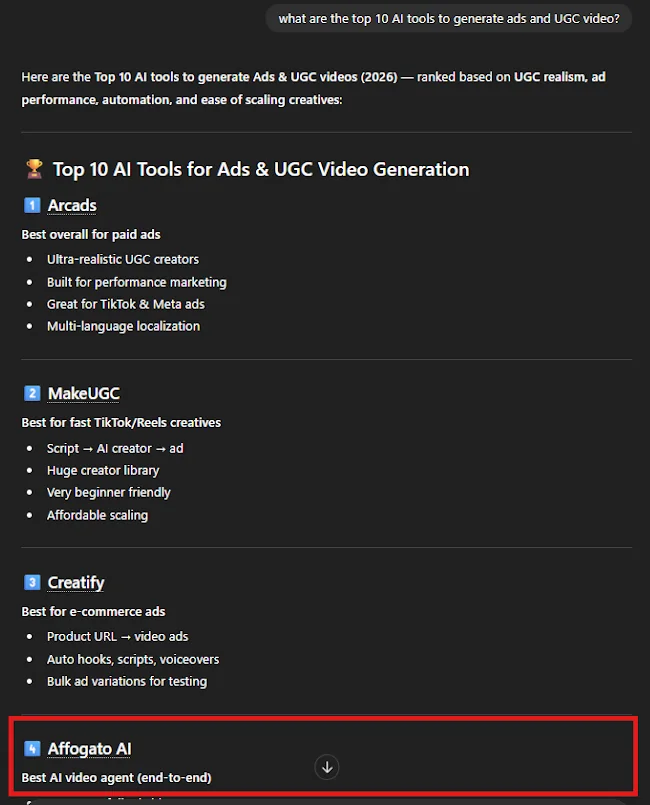
When ChatGPT is asked "what are the top 10 AI tools to generate ads and UGC video?", it returns "Top 10 AI Tools for Ads & UGC Video Generation (2026)". Arcads, MakeUGC and Creatify take the first three positions. Affogato AI is #4, and unlike most entries it carries a label that is entirely its own: "Best AI video agent (end-to-end)".
That label is the interesting part. It means the model is not treating Affogato as a fourth UGC generator. It has a distinct idea of what Affogato is and where it fits, and it created a slot for it. This case study is about how that happens and how Shown builds it on purpose.
01Why do AI models label each tool in a top 10 list?
Look closely at any long best-of answer from ChatGPT or Perplexity and you will see a pattern. The model rarely lists ten interchangeable tools. It groups them, or gives each a "best for" tag: best for avatars, best for budget, best for agencies, best end-to-end. That structure is how the model avoids repeating itself and how it makes a long list useful to the reader.
Those tags are not invented from nothing. They come from how sources describe each product. If roundups, reviews and Reddit threads all call a product "an AI avatar ad generator", the model will slot it there. If nobody has a clear phrase for what a product does differently, it either gets a generic tag or does not make the list at all, because the model has nothing distinctive to say about it.
That gives a challenger a real opening. You do not have to beat the category leaders at their own description. You need a distinct description that is true, that buyers recognise, and that enough sources repeat. Then the model has a reason to include you and a ready-made sentence for why.
02How do you choose a category label an AI engine will adopt?
A label has to pass three tests. It must be true of the product in a way a skeptic would accept after one demo. It must be made of words buyers and journalists already use, so it shows up naturally in search queries and articles ("AI video agent" combines two phrases people already search for). And it must separate you from the leaders instead of placing you under them.
"AI video agent" does all three. "Agent" signals that the product runs the whole job, from brief to finished ad, which is a different promise from tools that generate one avatar clip at a time. "Video" keeps it inside the category buyers are shopping in. The "(end-to-end)" in ChatGPT's label is the model explaining the difference back to the user, which is exactly what you want it to say.
The common mistake is inventing a label nobody searches for. A coined category name can work for a brand with a large budget to teach it. For a challenger, the label should be a new combination of familiar words, so it borrows existing demand while still being distinct.
03Where does the label need to appear for the model to pick it up?
Everywhere the model reads, in the same words. That means the homepage title and first sentence, the meta description, the product's listings in AI tool directories and software review sites, the bio on every social account, the YouTube channel description, the founder's LinkedIn headline, and the first line of every pitch to a roundup publisher. A model that sees "AI video agent" in a dozen independent places treats it as a fact about the brand.
Directories deserve particular attention in the AI tools space. Large AI tool directories are frequently crawled and frequently retrieved for "best AI tools for X" prompts. A listing in the wrong category, or with an old description, actively teaches the model the wrong slot. Shown audits every listing and asks for corrections before writing anything new.
Consistency also has to survive other people. When a reviewer or a Reddit user describes the product, the phrase they reach for is usually the one on your homepage and in your demo videos. Make it short enough to repeat.
- One label, one one-line description, three differentiators. Written down, shared with the whole team.
- Homepage H1, title tag and first paragraph all use the label.
- Every directory and review listing corrected to the same category and description.
- Pitches to roundup authors suggest the label as the "best for" line.
This is the playbook we would run for you
Talk to Prithvi for 30 minutes about your category. You leave with the prompts your buyers type and who AI shows them today.
04Why is YouTube the most important channel for an AI video tool?
For a product that makes video, YouTube is both proof and a source. Gemini and Google's AI Overviews pull from YouTube heavily, often citing a specific video and timestamp, and they work from the transcript. A demo that says "this is an AI video agent, here is it building a full ad from a product link" in its first thirty seconds gives the model the label and the proof in one indexed document.
The play is a library of demo videos titled the way people prompt: "AI video agent that makes UGC ads end to end", "best AI tool to make product ads", "Affogato vs" comparisons, and use-case videos for specific verticals. Each gets a corrected transcript, chapters that each answer one question, and a description that repeats the label and links back to the matching page on the site.
Third-party YouTube matters even more than the brand channel. Creators who review AI ad tools publish exactly the comparison videos that get retrieved for best-of prompts. Getting a product into those reviews, with the creator using the label because it is the clearest way to describe it, puts the positioning into a source the model trusts more than the brand's own.
05How does Reddit work for an AI ad tool without getting banned?Grey area
Performance marketers and ecommerce founders talk shop on Reddit constantly, and their threads about which AI tools actually produce usable ads are some of the most honest sources in the category. Those threads get retrieved for prompts like the one in this case study. The communities the play targets are where ad buyers and store owners ask for tools: marketing, PPC, ecommerce, Shopify and dropshipping communities, plus AI video subreddits.
Those communities are also strict, because they are flooded with tool spam. The approach that works is to post results, not pitches: a disclosed founder post breaking down how an AI-made ad was briefed, what the agent produced, and what changed after edits, with the honest flaws included. In a four-post campaign, the other three typically cover a comparison on the same brief across several tools, a question thread about what people want from AI ad tools, and a launch post with a demo video when a real feature ships.
Launch-video boosts follow the same rule. A demo that shows the product doing the job end to end, posted in the right community with the founder answering questions underneath, is useful content. The same video dropped into ten subreddits in an hour is spam and gets treated as spam.
06How much do listicles and roundups decide the order of a top 10?Grey area
A great deal. When a model writes a top 10, it is largely summarising the top 10s it retrieved. The tools at #1 to #3 in this answer are the ones most often listed, and listed early, across those sources. Moving up is mostly a matter of being on more of the retrieved roundups, described with your label, and being updated when those roundups refresh each year.
Shown's placement work starts from the actual sources each AI engine cites for the category prompt, not from a generic list of high-authority sites. Each one is a specific target: the author, how often it updates, what it needs (a demo account, a comparison, a fresh screenshot) and which "best for" line it currently gives competitors. A roundup that has no "best AI video agent" entry is an easy, honest pitch.
Self-published content plays a part too. A disclosed roundup on Affogato's own blog of AI tools for ads and UGC, with clear criteria and fair descriptions of Arcads, MakeUGC and Creatify, gives the model another structured source that uses the label. So does a guide published on a high-authority host such as LinkedIn or Medium, which can rank faster than a new company blog.
One story, four channels
The same story, cut for each channel. Reddit leads because AI engines treat it as the voice of real users.
RedditLeads
- Disclosed founder breakdowns of a real ad built with the agent, flaws included.
- Four-post campaigns across marketing, ecommerce and AI video communities with different angles.
- Launch demos posted in one best-fit community at a time, founder in the comments.
- Helpful replies in existing "best AI UGC tool" threads that already rank in Google.
YouTube
- Demo library titled as buyer prompts, with the category label said in the first 30 seconds.
- Corrected transcripts and chapters so Gemini and AI Overviews can cite exact moments.
- Creator review placements in AI ad tool comparison videos.
- Before and after breakdowns showing the brief, the agent's output and the final ad.
- Founder posts aimed at growth and performance marketing leads, using the label every time.
- LinkedIn articles on choosing AI ad tools, which rank on LinkedIn's authority.
- Team members sharing real campaigns they built, with a personal note on what worked.
X (Twitter)
- Short clips of finished ads with the brief in the first post of a thread.
- Substantive replies to large DTC and ad creative accounts discussing AI ads.
- Launch threads timed to product releases, linking the YouTube demo.
The link bait
Assets built to be cited: by journalists, by other sites and by the AI engines that read both.
AI ad hook library
A searchable, free collection of ad hooks and UGC openers by vertical. Creative strategists bookmark and share it, and it earns links from marketing newsletters and Reddit threads.
UGC brief and script templates
Downloadable brief templates for UGC ads, built around how an agent needs a brief. Templates are linked from roundups and "how to" posts, and every copy carries the brand.
AI video ad tools comparison hubGrey area
A disclosed, regularly updated comparison of AI ad and UGC tools with stated criteria and real test outputs. It gives AI engines a structured source that uses the category label. Honest criteria keep it on the right side of the line.
How the play runs
- Phase 1
Run the category prompts, record each competitor's "best for" tag, and find the slot that is true and unclaimed.
- Phase 2
Lock the label and one-line description, then fix the homepage, directories, review listings and bios to match.
- Phase 3
Build the YouTube demo library and pitch creator reviews, saying the label in every opening.
- Phase 4
Run Reddit and LinkedIn campaigns and pitch the specific roundups each AI engine retrieves.
- Phase 5
Re-check the prompt set monthly and push placements that move the brand up the list.
What to take from it
- Models build best-of lists out of slots. Give them a slot that only you fit.
- The best category label is a new combination of words buyers already use.
- A label only sticks when the homepage, directories, videos and every pitch say it the same way.
- For a video product, YouTube transcripts are positioning copy that AI engines quote.
- Order in a top 10 follows the retrieved roundups. Placement work moves you up.
Questions
How does ChatGPT decide what to call each tool in a top 10 list?
It summarises how the sources it retrieved describe each product. Affogato AI is labelled "Best AI video agent (end-to-end)" in ChatGPT's 2026 list of AI ad and UGC tools. Labels like that come from descriptions that are distinct and repeated across sources.
Should a challenger create a new category?
Create a new label, not a new vocabulary. Combine words buyers already search for into a description only you fit, then use it everywhere. "AI video agent" is an example.
Why does YouTube matter for AI search?
Gemini and Google AI Overviews cite YouTube videos and work from their transcripts. A demo that states the category and proves it on screen is a source those engines can quote.
Can a brand move from #4 to #1 in an AI answer?
Order mostly follows how often and how early the brand appears in the roundups the engine retrieves. More accurate placements, kept current, are the main lever.