What buyers in deeptech ask AI
These are the prompts we track for deeptech companies. Each one fans out into several searches behind the scenes, and every search is a chance to be one of the sources the answer is built from.
- how does AI vehicle damage inspection work
- best AI vehicle inspection software for insurers
- computer vision accuracy for car damage detection
- companies building solid state battery technology
- best industrial machine vision system for defect detection
- LiDAR vs camera for warehouse robotics
- which startups are working on synthetic biology for materials
- how accurate is AI for claims estimation
Where AI engines look for deeptech answers
For 'how does X work' and accuracy questions, engines reach for research. A preprint with your method and results makes your company citable on its own terms.
Patents establish who invented what. Engines use them to answer 'which companies are working on X'.
Sector press (insurance, automotive, energy, robotics) is the bridge between research and buyers, and is retrieved for commercial prompts.
Talk pages, slides and recorded sessions are indexed. They tie a named expert to a topic, which strengthens the entity.
Engineers discuss what works in practice. Those threads are cited for comparison and 'is it any good' prompts.
Where a technology has an article, engines use it to define the field. Being accurately referenced there, through reliable sources, shapes the definition.
Clear, sourced explanations of how the technology works are often the passage engines lift for 'how does X work'.
The subreddits that matter
01Why is AI visibility different for deeptech companies?
Deeptech buyers ask harder questions. Instead of 'best tool for X', they ask 'how accurate is computer vision at detecting hail damage' or 'what are the limits of solid state batteries at low temperature'. Engines answer those with research, standards bodies, trade journals and technical explainers, not with listicles.
That changes the job. A deeptech company does not need fifty blog posts. It needs a small number of authoritative pages that explain the technology precisely, with sources, and a presence in the places engines trust for technical claims. When the engine's fan-out queries retrieve 'how does AI vehicle inspection work', your explainer should be the clearest passage it finds.
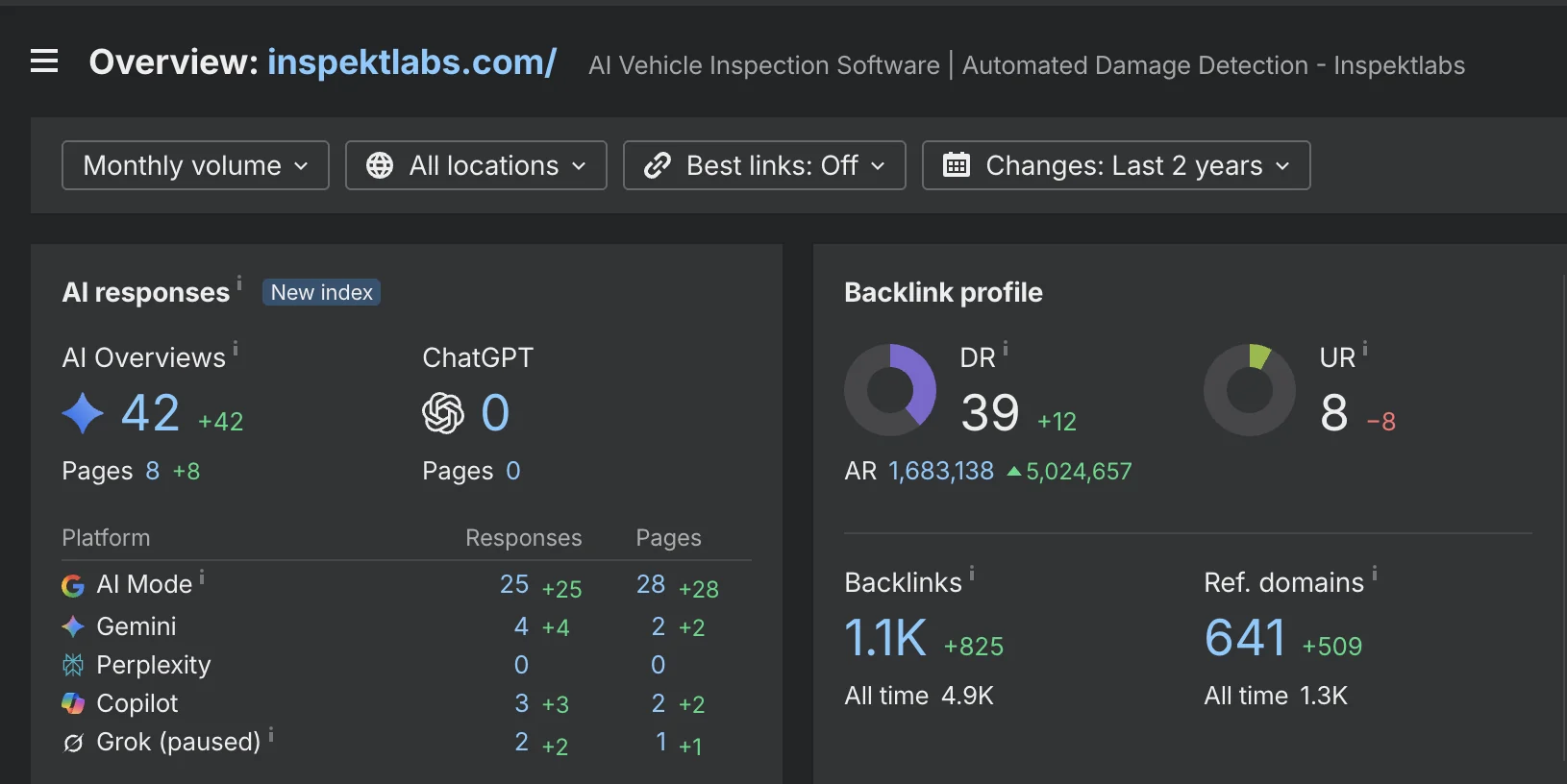
Inspektlabs shows the outcome. It builds AI vehicle inspection, and went from 0 to 76 AI answers, with 42 in Google AI Overviews and 25 in AI Mode, while its Domain Rating rose from 27 to 39. The topic is narrow and technical, which is exactly why a well-built source can own it.
02Do research papers and patents help a company get cited by AI?
Yes, if they are findable and connected to the company entity. Engines retrieve arXiv preprints, Google Scholar results and patent pages for technical prompts. A preprint that describes your method, your dataset and your measured accuracy makes your claims citable by anyone, including the model.
The connection matters. Link each paper and patent from a research page on your site, use the same company name and author names everywhere, and write a plain-language summary page for each one. The summary is what buyers and engines will actually read; the paper is what makes it credible.
Do not overclaim. Engines and expert readers both punish accuracy numbers without a stated test set. 'X% accuracy on our internal dataset of N images, defined as...' is quotable. 'Industry-leading accuracy' is not.
03Can Reddit work for a technical deeptech company?Grey area
It works better than most deeptech teams expect, because technical subreddits are short on genuine experts. An engineer who answers a hard question in r/computervision or r/AskEngineers with a correct, specific answer becomes a known name quickly, and those threads are retrieved when buyers ask engines the same question.
The play is expert-first. Engineers and researchers from the company participate under their own names or disclosed accounts, answering questions in their field for weeks before anything about the product is posted. Then the four-post campaign runs: a technical write-up of a hard problem you solved, a results post with method and numbers, an industry post in a buyer subreddit (r/Insurance for vehicle inspection, for example), and an open question that invites practitioners to share how they solve it today.
Deeptech posts fail when they read like press releases. They succeed when they include a diagram, a failure case and an honest statement of what the technology cannot yet do. Technical audiences upvote candour.
- Separate research subs (r/MachineLearning) from buyer subs (industry communities). Write differently for each.
- Lead with the problem and the method, not the company.
- Include limitations and failure cases: they make the post credible and quotable.
- Have the engineer who did the work answer comments, not a marketer.
04How do trade journals and conference talks feed AI answers?
Trade publications bridge the gap between research and the buyer's world. An article in an insurance, automotive, energy or manufacturing trade journal describing your technology in the buyer's language is retrieved for commercial prompts that a paper never will be.
The play is contributed articles and data. Offer editors an expert byline on a question their readers struggle with, with original figures from your work. Conference talks do similar work: the talk page, the slides on SlideShare or Speaker Deck, and the recorded video all tie a named expert to the topic, which strengthens both the person's and the company's entity.
Republish talks as written explainers on your own site and as LinkedIn articles. Each version is another retrievable passage with the same claim, which is how entity consistency is built.
Analyst and market-map coverage works the same way. Industry analysts, market maps and 'companies working on X' roundups are retrieved when buyers ask who is active in a field. Briefing analysts and supplying accurate descriptions to the authors of those maps costs little and shapes how engines list the category.
05What pages should a deeptech company build for AI search?
Start with the questions buyers ask before they know you exist. For Inspektlabs-type companies that means 'how does AI vehicle inspection work', 'how accurate is AI damage detection', 'AI inspection vs manual inspection' and 'how insurers use AI for claims'. Each becomes a page that answers in the first two sentences, then goes deep with diagrams, sources and limitations.
Add a glossary of the field's terms, a standards and compliance page, use-case pages per industry, and a comparison page that fairly maps approaches (camera vs LiDAR, rules-based vs learned). These are the pages engines lift for definitional and comparison prompts.
- One explainer per core 'how does X work' question.
- Accuracy and methodology pages with test sets defined.
- Glossary and standards pages that define the field's terms.
- Industry use-case pages written in the buyer's language.
- Organization, Person and ScholarlyArticle schema tying authors, papers and the company together.
06Should a deeptech company be on Wikipedia?
Only when notability is real, meaning significant coverage in independent reliable sources. Writing your own article is a conflict of interest and usually gets deleted. The useful work is upstream: earn the trade and mainstream coverage that would justify an article, and make sure existing articles about your technology area cite reliable sources accurately.
Wikidata entries and consistent entity information across Crunchbase, LinkedIn, patent filings and your site help engines resolve who you are. For deeptech, where company names often collide with technical terms, that disambiguation is worth doing early.
Running AI visibility for deeptech companies?
Book 30 minutes with Prithvi. We run your buyers' prompts first, so the call starts with where you stand.
One story, four channels
How we run each channel for deeptech companies. Reddit leads, because it is where AI goes for recommendations.
RedditLeads
- Expert-first participation by named engineers in technical subreddits.
- Four-post campaigns: technical write-up, results with method, buyer-subreddit post, open question.
- Separate tone for research subs and industry buyer subs.
- Answer hard questions in old, still-ranking threads with precise, sourced replies.
YouTube
- Technical demos showing the system working on real cases, including failures.
- Recorded conference talks uploaded with chapters and transcripts.
- Short explainers answering one 'how does X work' question each.
- A modest paid boost on launch and demo videos to reach engineers in the first week.
- Researchers and founders posting findings and figures, linking to the explainer.
- LinkedIn articles republishing conference talks in written form.
- Posts aimed at the buyer industry's procurement and operations leaders, not other technologists.
X (Twitter)
- Threads summarising new papers with the key figure as an image.
- Engaging with researchers and analysts in the field.
- Live coverage of conferences you present at.
Link bait that works in this market
Assets built to be cited: by journalists, by other sites, and by the AI engines that read both.
Open dataset or benchmark
A released dataset or evaluation that others in the field use. It earns citations from papers, blogs and engines for years.
State of the technology report
An annual review of where the field stands, with sourced figures. Trade journals and engines cite it for definitional prompts.
Interactive explainer or visualiser
A tool showing how the technology works step by step. Gets linked from courses, forums and Reddit.
Technical comparison page of approachesGrey area
A fair map of competing methods, including yours. Retrieved for 'X vs Y' prompts.
Buyer's evaluation checklistGrey area
The questions a procurement or engineering team should ask any vendor in your field, including what good answers look like. Buyers share it internally; engines cite it for 'how to choose' prompts.
White hat, grey hat, and the line
AI visibility rewards whoever shows up in the sources first. Some of the fastest moves sit in a grey zone. Here is exactly where we stand.
White hat
What we do every time
- Preprints and plain-language explainers for each core claim
- Contributed articles in trade journals
- Conference talks republished as written explainers
- Expert participation in technical communities
- Consistent entity data across patents, Crunchbase and the site
Slightly grey
What we do with care, in the open
- Republishing talks and papers on LinkedIn and Medium to borrow authority
- Comparison pages of competing approaches that include your own
- Seeding technical questions you are well placed to answer, with disclosure
- Reviving old technical threads with precise, useful answers
Never
The line we do not cross
- Unverifiable accuracy claims or numbers without a test set
- Writing your own Wikipedia article or editing it undisclosed
- Undisclosed sockpuppet experts
- Bought upvotes or coordinated voting
- PBN links or paid placements disguised as journalism
Questions from deeptech companies
How do deeptech companies get cited by ChatGPT?
By making their technical claims available in sources engines trust for hard questions: explainer pages, preprints, patents, trade journals and technical forums, all describing the company consistently.
Is SEO worth it for a deeptech startup with few searches?
Yes, because low volume does not mean low value. Narrow technical topics are easier to own, and a single buyer can be worth a year of traffic. Inspektlabs went from 0 to 76 AI answers in its niche.
Should engineers be posting on Reddit?
If they want to, yes. Named experts answering hard questions are the most credible voice a deeptech company has. Disclosure is non-negotiable.
Do patents help with AI visibility?
They help engines answer 'which companies are working on X'. Link each patent from a plain-language summary on your site so the claim is easy to retrieve.
Who should own deeptech content, marketing or engineering?
Both. Engineers supply the substance and review every claim; marketing turns it into answer-first pages, distribution and placements. Content written by marketing alone tends to overclaim, and content written by engineers alone tends to bury the answer.
What results has Shown achieved for deeptech?
Inspektlabs, an AI vehicle inspection company, went from 0 to 76 AI answers, including 42 Google AI Overviews and 25 AI Mode answers, while Domain Rating rose from 27 to 39.