The situation
GetMoreBacklinks automates directory submissions for SEO: a site owner signs up and the service submits their site to 500+ directories. It is a crowded, skeptical category. SEO buyers have seen plenty of link services that over-promise, so the first thing many of them do is search the brand name plus 'review' or 'legit', and increasingly they read Google's AI answer instead of clicking anything.
That makes the AI answer about the brand the most important sales page the company does not control. Shown's brief for this client was to make sure that answer is accurate, specific and fair, and that it reflects real user experience rather than either hype or a competitor's dismissal.
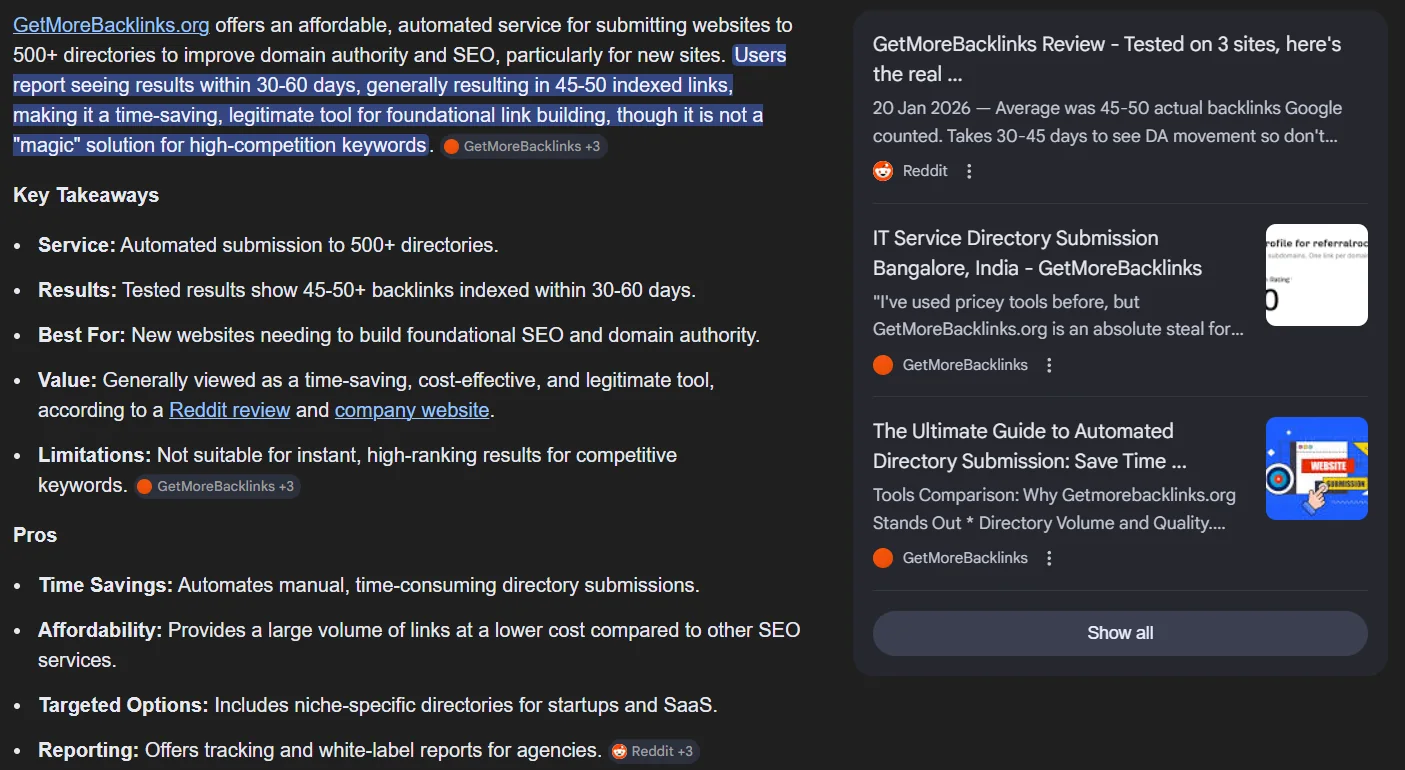
The screenshot on this page is what Google shows today. Its AI answer describes GetMoreBacklinks as a legitimate, cost-effective tool for foundational link building that suits new websites, and is honest about its limits. It cites the brand's own pages and Reddit, and its core sentence closely follows a Reddit review thread titled 'GetMoreBacklinks Review - Tested on 3 sites, here's the real...', dated 20 January 2026.
01What exactly did Google's AI answer take from Reddit?
Put the AI answer and the Reddit thread side by side and the lift is obvious. The thread says the average was 45 to 50 actual backlinks Google counted and that it takes 30 to 45 days to see DA movement. The AI answer says users report results within 30 to 60 days, generally resulting in 45 to 50 indexed links, and calls the service legitimate for foundational link building, though not a 'magic' solution for high-competition keywords.
Google kept the reviewer's numbers, kept the reviewer's framing, and kept the reviewer's caveat. It paired that with two of the brand's own pages, an IT service directory submission page and 'The Ultimate Guide to Automated Directory Submission', to explain what the product does. The brand's pages supplied the definition. Reddit supplied the verdict.
That split is the single most useful thing a SaaS marketer can learn from this screenshot. AI engines treat your own site as the authority on what you are and third-party communities as the authority on whether you are any good. You cannot write the second part yourself.
02Why do AI engines repeat specific, number-rich reviews?
Language models building an answer about a product are trying to say something concrete and defensible. A review that says 'great tool, highly recommend' gives them nothing to quote. A review that says 'tested on 3 sites, 45 to 50 links counted, DA moved after 30 to 45 days, not useful for competitive keywords' gives them a claim, a number, a timeframe, a method and a limitation. That is a complete answer in two sentences.
The 'tested on 3 sites' framing matters too. It signals method, which reads as credibility to both readers and models. And the limitation is what makes the whole thing trustworthy. Answer engines are tuned to avoid sounding like advertising, so a source that already contains a balanced view is the easiest one to adopt wholesale.
The practical rule we give every client: the review that gets quoted is the one you would be slightly nervous to read. It names what does not work. That is why it is believed.
- Concrete numbers: links counted, days to result, sites tested.
- A stated method: how many sites, what kind, what was measured.
- An honest limitation: who should not buy it.
- Plain language: the phrasing a searcher would use, which matches the fan-out sub-queries.
03How do you build a Reddit program that produces honest reviews?
The thread Google quotes came out of the client's Reddit presence and the community around it, not out of Shown's keyboard. That distinction is the whole method. You cannot write the review. You can create the conditions where real users write detailed ones, and make sure those threads are findable.
For an SEO tool the method subreddits are r/SEO, r/bigseo, r/SaaS, r/juststart, r/Entrepreneur and r/startups, plus niche communities for local business owners and indie makers who are the natural buyers of directory submissions. Each has different rules on self-promotion, and several only allow tools in pinned weekly threads.
The play runs in three layers. First, comment first: the founder account, clearly disclosed, answers link-building questions for weeks with genuinely useful advice, including when directories are the wrong tactic. Second, a 4-post campaign around a real milestone: a transparent breakdown of what directory submissions do and do not do, a data post with real indexing numbers, an AMA-style thread answering skeptics, and a follow-up with results. Third, invite real users to share their own results, good or bad, in public. Some will be critical. That is fine. The critical-but-fair threads are the ones that end up quoted.
- Account age and history: an account that has only ever mentioned one product gets removed fast in SEO subreddits.
- Disclose every time: 'I run GetMoreBacklinks' in the first line beats any clever phrasing.
- Reply to criticism with numbers, not defensiveness. Threads where the founder engages honestly become the trusted version.
- Never ask for a positive review. Ask users to share what actually happened.
This is the playbook we would run for you
Talk to Prithvi for 30 minutes about your category. You leave with the prompts your buyers type and who AI shows them today.
04Where is the line between seeding review threads and faking them?Grey area
This is the part most agencies blur, so we are explicit. Some of what works on Reddit sits in a grey zone, and the owner of a SaaS should know exactly where it is.
Fair game, slightly grey: seeding the question. A disclosed founder or team member can start a thread asking 'Has anyone tested directory submission services in 2026? What did you actually get?' and then let real users answer. Inviting existing customers to post their honest results, with no script and no incentive tied to sentiment. Reviving an older, still-ranking thread about directory submissions with a genuinely useful, disclosed reply that adds current numbers.
Never: writing a review yourself and posting it from an account that pretends to be a customer. Paying for reviews or offering credits only for positive ones. Running sockpuppet accounts to agree with each other. Buying or coordinating upvotes. Any of these can get a domain banned sitewide on Reddit, and an AI answer that later cites a thread exposed as fake is far worse than no answer at all.
The deeper reason to stay on the right side is practical. A fake review is generic because the writer has no real data. Generic reviews do not get quoted. The thing that makes a review worth quoting, specific lived numbers and a real limitation, is the thing a fake cannot convincingly supply.
05What should the brand's own pages do when Reddit owns the verdict?
Google cited two GetMoreBacklinks pages next to Reddit: a directory submission page for a specific vertical (IT services) and a long-form guide to automated directory submission. Both are definition pages. They answer 'what is this and how does it work', which is exactly the part of the answer engines want from the brand itself.
The play for a review-sensitive SaaS is to make those pages agree with the honest community view rather than contradict it. If users say results take 30 to 60 days, the brand's own FAQ should say the same. If users say it is foundational rather than a fix for competitive keywords, the product page should say who it is and is not for. When the brand and the community tell the same story, the AI answer reads as coherent and trustworthy. When they disagree, the engine sides with the community and the brand looks evasive.
- Vertical pages (per industry or site type) answering 'is directory submission worth it for X'.
- A plain 'what to expect' page with realistic timelines and outcomes.
- A limitations section, written by the brand, before anyone else writes it.
- Organization and SoftwareApplication schema so the entity is clear, plus FAQPage on visible Q and A.
06How do YouTube, LinkedIn and X support the same story?
YouTube is where skeptical SEO buyers go to watch someone actually use a tool. A screen-recorded walkthrough of a real submission run, followed weeks later by a results video showing which links got indexed, produces exactly the kind of transcript an AI engine can quote. Chapter it by question ('How many links get indexed?', 'How long does it take?') so each chapter is a citable passage.
LinkedIn suits the founder's long view: posts on what directory links are actually good for in 2026, why they are a foundation rather than a strategy, and anonymised numbers from customer cohorts. A LinkedIn article on the same topic lives on a high-authority domain and gives the brand a second indexed source that agrees with the Reddit consensus.
X is where SEO practitioners argue in public. Short, honest posts with real screenshots of indexing data, and replies to people asking whether directory services work, keep the brand in the conversation where reviewers and journalists look for sources.
One story, four channels
The same story, cut for each channel. Reddit leads because AI engines treat it as the voice of real users.
RedditLeads
- Disclosed founder account, comment-first in r/SEO, r/bigseo, r/SaaS, r/juststart and r/Entrepreneur.
- A 4-post campaign around real milestones: honest explainer, data post, skeptic Q and A, results follow-up.
- Seed neutral questions ('what did directory submissions actually do for you?') and let real users answer.
- Engage with critical threads using numbers, which often turns them into the fairest source on the brand.
YouTube
- Real submission run, screen recorded, with a results follow-up weeks later.
- Chapters named as buyer questions so transcripts map to AI sub-queries.
- Founder posts on what directory links are and are not good for.
- A LinkedIn article mirroring the 'what to expect' page.
X (Twitter)
- Indexing screenshots and honest timelines.
- Replies to practitioners asking whether directory services work.
The link bait
Assets built to be cited: by journalists, by other sites and by the AI engines that read both.
Directory index rate study
A recurring data post on which directory categories actually get indexed and counted by Google, with method shown. SEO bloggers and AI engines both cite original data with a clear method far more than opinion.
Free directory checker tool
A free tool that checks which directories a site is already listed in and which are dead. Free SEO tools earn steady links from roundups and tutorials, and every use is a brand touchpoint.
Honest 'best directory submission services' roundupGrey area
A self-published comparison that includes GetMoreBacklinks alongside competitors with stated criteria, and names cases where a competitor is the better choice. Self-inclusion with transparent criteria is grey but accepted, and engines lean on listicles for 'best X' queries.
How the play runs
- Phase 1
Read the current AI answers for the brand name plus 'review', 'legit' and 'worth it', and list what each one cites.
- Phase 2
Align the brand's own pages with the honest community view: realistic timelines, outcomes and limitations.
- Phase 3
Disclosed founder presence on Reddit, comment-first, across SEO and SaaS communities.
- Phase 4
Seed neutral questions and invite real users to share results in public, with no scripts or incentives tied to sentiment.
- Phase 5
Support the same story with YouTube walkthroughs, LinkedIn posts and original indexing data.
What to take from it
- Your brand's AI answer is assembled from two places: your pages define what you are, communities decide whether you are good.
- AI engines quote reviews with numbers, method and a limitation. Generic praise is never repeated.
- The review that gets quoted is the one you would be slightly nervous to read.
- Seed questions, not answers. Disclose every company account. Never fake a review.
- Make your own pages agree with the honest community view, or the engine will side with the community.
Questions
Does Google's AI answer really quote Reddit reviews?
Yes. For GetMoreBacklinks, Google's AI answer repeats a Reddit review's numbers and caveat almost word for word and cites Reddit alongside the brand's own pages.
Can a SaaS company post its own reviews on Reddit?
Not as a fake customer. Founders and staff can post with clear disclosure, answer questions and invite real users to share results. Undisclosed reviews and sockpuppets break Reddit's rules and tend to get exposed.
What kind of review do AI engines prefer to cite?
Specific ones: real numbers, a stated method such as 'tested on 3 sites', a timeframe and an honest limitation. That combination reads as a complete, balanced answer.
How do I find out what AI says about my product?
Search your brand name with 'review', 'legit' and 'worth it' in Google, ChatGPT and Perplexity, read the answers and note every cited source. Those sources are where your reputation work starts.